Algorithm Discovery and Design
By the end of this chapter, you will be able to explain the benefits of pseudocode over natural language or a programming language, Represent algorithms using pseudocode; Identify algorithm statements as sequential, conditional, or iterative; Define abstraction and top-down design, and explain their use in breaking down complex problems; Illustrate the operation of algorithms for: Multiplication by repeated addition, Sequential search of a collection of values, Finding the maximum element in a collection; and Find a pattern string in a larger piece of text
Presentation of algorithms
Natural language - everyday languages spoken by populations
Most familiar language
Complicated algorithms may lead to an unstructured, “free-flowing” style, complicating the ability to understand the parts of the algorithm
Many words and phrases have different possible interpretations
Formal cs language
Issue with details such as punctuation, grammar, and syntax
Pseudocode
The compromise between the two extremes
Set of english language constructs designed to resemble statements in a programming language but lacks the ability to run on a computer
Highly readable and no grammatical rules
Contains only statements with a well defined structure → easier visualization of how the algorithm works
Pseudocode Operations
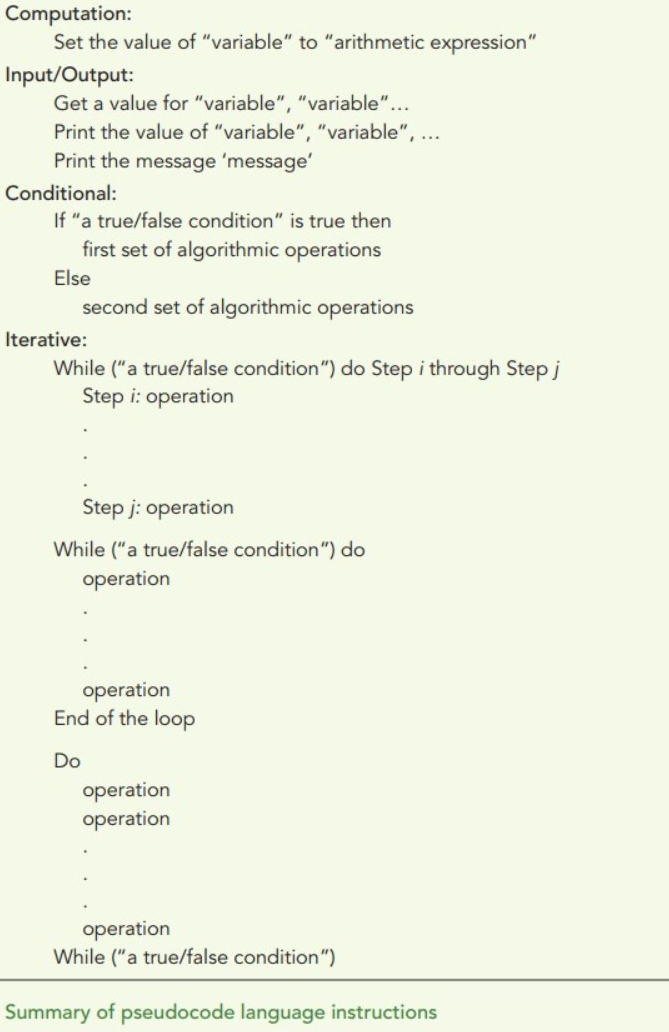
Consists of three basic operations called computation, input, and output
Computations evaluate expressions and stores the results in variables
Variables are a named storage location that can hold data value
Input operations provide computations with data values from the outside world that may be used later on
Output operations return the results of computation(s) using the data provided
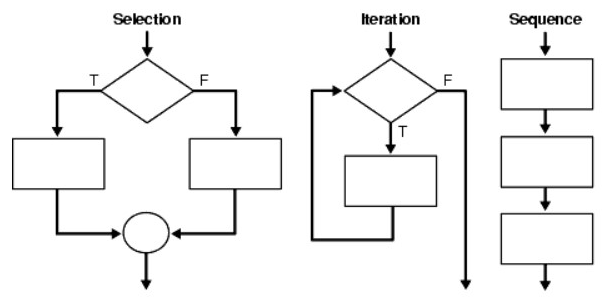
Sequential, Conditional, and Iterative Operations
The Flow of each Operation
.
How Each Operation Works
Schneider, G. Michael, and Judith L. Gersting. Invitation to Computer Science. Cengage Learning, 2019